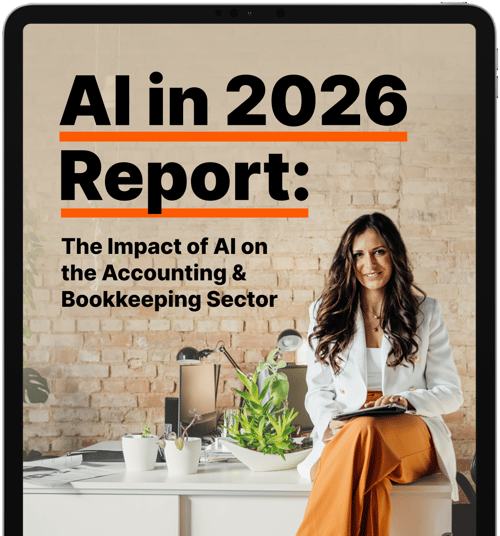

AI in Accounting and Bookkeeping
What 1,500+ accountants are seeing in practice from early adoption to real-world application.
Download the full report
The Power of Applied AI Report provides:
Data on how firms are using AI today
Insight into where AI delivers the most value
Analysis of common risks and challenges
A framework for applying AI effectively in your firm
Insights from 1,500+ accountants and bookkeepers
👉 Download the report to apply AI with greater clarity and confidence
The Power of Applied AI Report: How firms are embracing AI in 2026
AI adoption is accelerating across accounting, but results are mixed.
This report uncovers how firms are really using AI today, where it’s creating risk, and how to apply it in a way that delivers accuracy, control, and measurable impact.
AI adoption is accelerating across accounting, but results are mixed.
This report uncovers how firms are really using AI today, where it’s creating risk, and how to apply it in a way that delivers accuracy, control, and measurable impact.
Download the report
Insights from 1,500+ accountants and bookkeepers
Research across UK, Canada, and Europe
Real-world data on AI usage, risks, and outcomes
👉 Get the full picture of applied AI in practice
AI is moving fast. Results aren’t guaranteed.
AI is becoming part of everyday accounting workflows.
Firms are adopting new tools to automate tasks, improve efficiency, and scale their operations.
But adoption alone doesn’t guarantee results.
Many of the tools being used today weren’t built for accounting — leading to inconsistent outputs, increased errors, and additional time spent reviewing and correcting work.
This report brings together research and real-world data to show what’s working, what isn’t, and how firms can apply AI more effectively.
The reality of AI in accounting today
AI is widely used, but not always trusted. In many cases, firms and their clients are relying on general-purpose AI tools for financial decisions without the necessary controls.
The consequences are already clear:
Not all AI is the same
There is a clear difference between AI built for general use and AI designed for accounting workflows.
Public AI
General-purpose tools
Limited control and verification
Outputs that require significant validation
Applied AI
Built for specific financial tasks
Designed for accuracy and auditability
Integrated into existing workflows
Understanding this difference is key to applying AI successfully.
Where AI is creating challenges
Alongside these benefits, firms are also facing new risks.
Common issues include:
-
Incorrect expense categorisation
-
VAT/GST errors
-
Flawed tax advice
-
Payroll inaccuracies
These challenges increase the need for oversight, validation, and stronger controls.
What to consider when adopting AI
As AI becomes more embedded in workflows, firms need clear criteria for evaluating tools.
Key considerations include:
Data control
Accuracy and reliability
Auditability of outputs
Fit within existing workflows
Risk management and safeguards